Best Heavy Duty Monitor Arms
Quick answer
The VIVO Premium Aluminum Monitor Arm for ultrawide screens (B07L8MLTGS, $99.99) is the best heavy duty pick because its pneumatic mechanism is rated up to 33 lb and supports panels up to 49 in, which covers a 34 in or 38 in ultrawide with headroom. The Modernsolid Heavy Duty Monitor Arm (B0F6T4WM6L, $149.99) is built specifically for 34 to 49 in curved ultrawide panels for the largest screens.
Picks are ranked from published weight ratings, panel size compatibility and verified owner reviews on Amazon. No unit was tested in person.
A 32 in 4K panel or a curved ultrawide weighs meaningfully more than a standard 24 or 27 in monitor, and the pick that earns Top Pick here is the VIVO Premium Aluminum Monitor Arm (B07L8MLTGS) at $99.99, a pneumatic single arm rated up to 33 lb and built for panels up to 49 in, which gives a 34 in ultrawide real headroom instead of sitting near the arm ceiling.

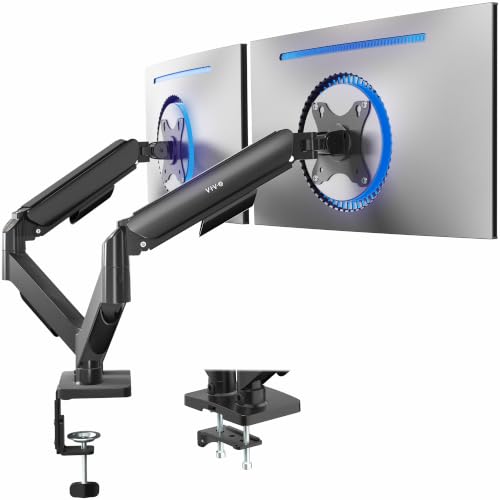
VIVO Premium Aluminum Monitor Arm for Ultrawide Screens up to 49 inches and 33 lbs, Heavy Duty Single Desk Mount, Pneumatic Height, Max VESA 100x100, Black, STAND-V101G1
A 33 lb pneumatic rating and support up to 49 in covers a 34 in or 38 in ultrawide panel with real headroom rather than sitting near the arm ceiling from day one.
The three tiers
MOUNTUP Heavy Duty Dual Monitor Mount Holds 6.6-33lbs for Ultrawide Screen
This MOUNTUP heavy duty mount is rated 6.6 to 33 lb and built for ultrawide screens, which covers most single large panels at a lower price than a dedicated pneumatic arm.
The trade off: It is built and priced as a dual-capable mount pressed into single heavy-panel duty, so a buyer wanting the smoothest pneumatic height adjustment on one large screen should expect a firmer, more manual feel.
- Starter
MOUNTUP Heavy Duty Dual Monitor Mount Holds 6.6-33lbs for Ultrawide Screen
$87.99 Check pricePrices change often

VIVO Premium Aluminum Monitor Arm for Ultrawide Screens up to 49 inches and 33 lbs, Heavy Duty Single Desk Mount, Pneumatic Height, Max VESA 100x100, Black, STAND-V101G1
The VIVO Premium Aluminum arm uses a pneumatic height mechanism rated up to 33 lb for screens up to 49 in, which handles a 34 or 38 in ultrawide with room to spare in the rated range.
The trade off: A pneumatic single arm this capable takes up a noticeably larger footprint at the clamp point than a standard single arm, which matters on a narrow desk.
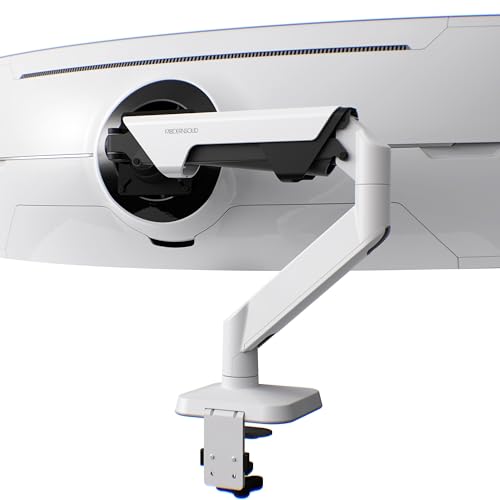
Modernsolid Heavy Duty Monitor Arm for 34-49 Inch Ultrawide Curved Screens
Built specifically for 34 to 49 in curved ultrawide panels, this is the arm to buy once and not think about again if your monitor is at the largest end of what a home office desk holds.
The trade off: That size focus means it is not the right choice for a standard 24 to 27 in monitor, where a lighter arm handles the weight for far less money.
Who should not buy it: Anyone with a monitor smaller than about 32 in, where a standard single arm already has enough capacity and this size-specific build adds cost without benefit.
- Ceiling
Modernsolid Heavy Duty Monitor Arm for 34-49 Inch Ultrawide Curved Screens
$149.99 Check pricePrices change often
How we chose
We did not test any of these arms in person. Rankings come from the weight ratings and panel size compatibility published in each Amazon listing, cross-checked against the approximate weight of the panel sizes each arm is marketed for, plus a read of verified owner reviews for complaints about sag or drift under large or curved panels specifically.
The three tiers span the real price range for heavy duty arms sold to home offices, from an entry-level heavy mount to a size-specific ultrawide arm, rather than defaulting to the cheapest options available.
What makes an arm heavy duty rather than standard?
A standard single arm is typically rated up to somewhere around 20 lb, which comfortably covers a 24 or 27 in panel. A heavy duty arm is rated further up that scale and is built for panels in the 32 in and larger range, including curved ultrawide screens, where the extra glass and larger frame add real weight the joint and clamp have to hold all day.
How much does a 32 in or ultrawide panel actually weigh?
With the factory stand removed, a 32 in panel is roughly 15 lb, a 34 in ultrawide is roughly 18 lb, a 38 in ultrawide is roughly 23 lb, and a 49 in ultrawide is roughly 35 lb. That range explains why a standard arm rated for a 27 in monitor is the wrong tool for anything ultrawide.
| Panel size | Approx. weight |
|---|---|
| 32 in | ~15 lb |
| 34 in ultrawide | ~18 lb |
| 38 in ultrawide | ~23 lb |
| 49 in ultrawide | ~35 lb |
Does screen width change with an ultrawide aspect ratio?
Yes, and this matters for both clearance and viewing distance. A standard 16:9 panel width works out to about diagonal size multiplied by 0.872. A 21:9 ultrawide panel is proportionally wider for the same diagonal, working out to about diagonal size multiplied by 0.922, which is why a 34 in ultrawide feels dramatically wider on the desk than a 32 in 16:9 panel despite the smaller stated diagonal.
| Diagonal | Aspect ratio | Approx. width |
|---|---|---|
| 32 in | 16:9 | ~27.9 in |
| 34 in | 21:9 | ~31.3 in |
| 38 in | 21:9 | ~35 in |
Should the arm sit lower for a bigger screen?
The reference point for monitor height is the top edge of the usable screen, which should sit at or just below eye height. Because a larger panel is taller top to bottom, its center and its stand mount point end up lower than a smaller panel would need to be for the same eye-height top edge. A heavy duty arm needs enough downward adjustment range to place a tall ultrawide panel correctly, not just enough strength to hold its weight.
Clamp depth and VESA pattern on heavy duty arms
Larger and heavier panels sometimes step up from the common 100x100 mm VESA pattern to 200x100 mm, so it is worth confirming the exact pattern on a 32 in or larger monitor before buying an arm, since not every heavy duty arm supports both patterns out of the box.
Shop heavy duty and ultrawide-rated arms
Shown across the range this category actually spans, from $34.99 to $149.99, rather than the cheapest few.
- PUTORSEN
Heavy Duty Dual Monitor Arm for 17-49" Screens, Vertical Stack, 44lbs
$89.99 Check pricePrices change often - Modernsolid
Modernsolid Heavy Duty Monitor Arm for 34-49 Inch Ultrawide Curved Screens
$149.99 Check pricePrices change often



Buying tips
- Estimate your panel weight using the large-panel table above rather than guessing, since ultrawide panels are heavier than their diagonal size alone suggests.
- Confirm whether your large panel uses a 100x100 mm or 200x100 mm VESA pattern before ordering.
- Leave downward adjustment headroom in mind, since a larger panel needs to sit lower to keep its top edge at eye height.
- Measure desk clamp depth carefully, since heavy duty arm bases are often larger than standard single arm bases.
Get the desk setup checklist
One page: the measurements to take, the order to set them in, and the numbers to check against. Free, no spam.
The mailing list opens shortly. Every measurement it covers is already on this site, in the calculators and the fit tables, at no cost and with no address required.
Questions people ask
Do I need a heavy duty arm for a 32 in monitor?
A 32 in panel weighs roughly 15 lb with the factory stand removed, which is at or above the top of what many standard single arms are rated for. A heavy duty arm rated up to around 30 lb or more gives real headroom instead of running the standard arm near its ceiling.
Can a heavy duty arm hold a curved ultrawide monitor?
Yes, arms marketed specifically for ultrawide panels account for both the added weight and the curved profile of the VESA mount point. A standard flat-panel arm can usually mount a curved screen too, but a size-specific ultrawide arm is rated with that weight class in mind.
Why does my ultrawide monitor need to sit lower than a small monitor?
Monitor height is set by the top edge of the usable screen, which belongs at or just below eye height. A taller ultrawide panel has more screen below that top edge than a small monitor does, so its center and mount point end up positioned lower to keep that same top-edge reference correct.
Is a 200x100 VESA pattern the same as 100x100?
No, these are different mounting hole spacings on the back of the panel, and an arm built only for 100x100 mm will not bolt directly to a 200x100 mm panel without an adapter plate. Larger and heavier monitors more often use the wider 200x100 mm pattern, so it is worth checking your specific model.
How much wider is a 34 in ultrawide than a 32 in regular monitor?
A 32 in 16:9 panel is roughly 27.9 in wide. A 34 in 21:9 ultrawide panel works out to roughly 31.3 in wide, so despite the smaller stated diagonal on the 32 in screen, the ultrawide is noticeably wider on the desk because of its different aspect ratio.
What is the heaviest monitor a home office arm typically supports?
Among arms marketed for home offices, ratings commonly top out somewhere in the 30 to 35 lb range, which comfortably covers even a large curved ultrawide panel at roughly 18 to 23 lb. Panels heavier than that, such as some 49 in super-ultrawide screens, need to be checked individually against the specific arm rated maximum.