Best Dual Monitor Arms
Quick answer
The Heavy Duty Dual Monitor Arm for 17 to 49 in screens (B0F1TRLPPF, $89.99) is the best all-around dual arm because its 44 lb rated capacity and vertical stack option cover most two-monitor combinations, including a mixed pair. For two lighter 24 in panels on a budget, the VIVO Dual Monitor Desk Mount (B009S750LA, $34.99) covers up to 22 lb per screen.
Picks are ranked from published weight ratings, VESA compatibility and verified owner reviews on Amazon. No unit was tested in person.
Running two monitors side by side means the arm has to hold twice the weight of a single mount and give each screen independent adjustment, and the pick that earns Top Pick here is the Heavy Duty Dual Monitor Arm for 17 to 49 in screens (B0F1TRLPPF) at $89.99, rated for up to 44 lb combined with a vertical stack option for people who want one screen above the other instead of side by side.

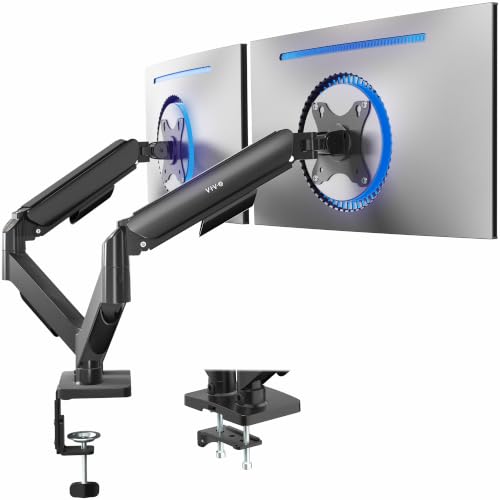
Heavy Duty Dual Monitor Arm for 17-49" Screens, Vertical Stack, 44lbs
A 44 lb combined rating and support up to 49 in per screen covers nearly any two-monitor combination, including a mixed pair or a vertical stack, without paying for capacity most people never use.
The three tiers
VIVO Dual Monitor Desk Mount, Holds 2 Computer Screens up to 30 inches and 22lbs Each, Heavy Duty Fully Adjustable Steel Stand with C-Clamp and Grommet, Black, STAND-V002
The VIVO Dual Monitor Desk Mount is a steel arm rated to hold two screens up to 30 in and 22 lb each, with a c-clamp and grommet base included, which covers a pair of 24 in office monitors comfortably.
The trade off: It uses a simpler friction joint rather than a gas spring, so repositioning either screen takes a firmer hand than a pneumatic arm.

Heavy Duty Dual Monitor Arm for 17-49" Screens, Vertical Stack, 44lbs
Rated for 17 to 49 in screens and up to 44 lb combined, with a vertical stack configuration available, this arm has enough headroom to handle a pair of 27 in monitors or a mixed 24 and 32 in setup without sitting near its ceiling.
The trade off: The larger footprint and taller pole take up more visual space on the desk than a lighter starter arm, which matters in a small home office.
- Buy once
Heavy Duty Dual Monitor Arm for 17-49" Screens, Vertical Stack, 44lbs
$89.99 Check pricePrices change often
Heavy-Duty Dual Monitor Arm Desk Mount for up to 35" Screens, Black
This heavy duty dual arm is built for screens up to 35 in per side, sitting at the top of the dual arm price range for people running two larger panels who want the extra build margin.
The trade off: At this price the jump over the 44 lb rated pick above is about desk footprint and per-screen size ceiling rather than a dramatically different mechanism, so it is worth it mainly if your panels are genuinely at the larger end.
Who should not buy it: Anyone running two standard 24 or 27 in monitors, where the Buy Once pick already has plenty of headroom.
- Ceiling
Heavy-Duty Dual Monitor Arm Desk Mount for up to 35" Screens, Black
$119.99 Check pricePrices change often

How we chose
We did not test any of these arms in person. Rankings come from the combined and per-screen weight ratings published in each Amazon listing, the VESA pattern each arm supports, and a pass through verified owner reviews looking for repeated complaints about drift, wobble or clamp slippage under real two-monitor loads.
The three tiers span the real price range for dual arms sold to home offices, from a basic steel mount to a heavier duty arm meant for larger panels, rather than defaulting to the cheapest three options.
How much weight does a dual monitor arm actually need to hold?
A dual arm has to support two panels at once, so the combined rating matters more than it does on a single arm. With factory stands removed, a pair of 24 in panels is roughly 16 lb combined, a pair of 27 in panels is roughly 22 lb combined, and a mixed 24 and 32 in pair is roughly 23 lb combined.
Buying an arm rated well above your combined weight, not just above it, leaves room for the spring or joint to age without sagging.
| Pairing | Approx. combined weight |
|---|---|
| Two 24 in panels | ~16 lb |
| Two 27 in panels | ~22 lb |
| 24 in + 32 in mixed | ~23 lb |
| Two 32 in panels | ~30 lb |
Side by side or vertical stack, which layout works better?
Side by side is the default and works well for most desk widths, keeping both screens at the same eye height with a small gap between them for the bezels. A vertical stack, with one screen above the other, saves desk width on a narrow desk and suits a workflow where one screen is a reference monitor that gets glanced at rather than read continuously, since only the lower screen sits at the ideal eye-height band.
How much desk depth does a dual arm recover?
Two factory stands together can occupy close to 18 in of combined desk depth. A dual clamp arm typically needs about 3 in of clamp depth at the back edge and cantilevers both panels forward from that single point, which recovers most of that depth for keyboard, mouse and paper space.
What spacing should sit between two monitors?
The gap between two adjacent screens should be small enough that the eye does not have to travel far to cross between them, but wide enough that the bezels and arm hardware do not collide when both are angled inward toward the seated position. Most dual arms leave this gap adjustable along the horizontal bar rather than fixing it.
| Panel size | Typical VESA pattern |
|---|---|
| 24 to 27 in | 100x100 mm |
| 32 in and larger or heavier panels | 100x100 mm or 200x100 mm |
Shop dual monitor arms
Shown across the range this category actually spans, from $34.99 to $119.99, rather than the cheapest few.
- MOUNTUP
MOUNTUP Heavy Duty Dual Monitor Mount Holds 6.6-33lbs for Ultrawide Screen
$87.99 Check pricePrices change often - PUTORSEN
Heavy Duty Dual Monitor Arm for 17-49" Screens, Vertical Stack, 44lbs
$89.99 Check pricePrices change often - QUARX
Heavy-Duty Dual Monitor Arm Desk Mount for up to 35" Screens, Black
$119.99 Check pricePrices change often


Buying tips
- Add up the approximate weight of both panels using the size-to-weight figures above before checking an arm rated capacity.
- Decide on side by side versus vertical stack before buying, since not every dual arm supports both layouts.
- Check the VESA pattern for each of your two monitors individually if they are different sizes or brands.
- Leave headroom above your combined weight rather than buying an arm whose maximum just clears it.
Get the desk setup checklist
One page: the measurements to take, the order to set them in, and the numbers to check against. Free, no spam.
The mailing list opens shortly. Every measurement it covers is already on this site, in the calculators and the fit tables, at no cost and with no address required.
Questions people ask
Can a dual monitor arm hold two different sized screens?
Yes, most dual arms adjust each side independently, so a mixed pair such as a 24 in and a 32 in monitor works as long as the combined weight and each panel individual weight fall inside the rated range and each panel VESA pattern is supported.
Do I need a gas spring dual arm or is friction enough?
Friction joints work fine for lighter pairs such as two 24 in panels that you rarely reposition. A gas spring arm is worth the extra cost if you adjust height or angle often, or if your combined panel weight sits in the middle to upper part of the arm rated range.
How much desk space does a dual monitor arm save?
Two factory stands can take up close to 18 in of combined desk depth. A single dual clamp arm typically needs about 3 in of clamp depth and cantilevers both screens forward from that point, recovering most of the desk depth the stands used to occupy.
Should my two monitors be at the same height?
For two monitors used as equal working displays, yes, keep the tops aligned near eye height so the eye does not have to refocus vertically when moving between them. A reference monitor that gets only occasional glances can sit slightly off that line without much downside.
Will a dual monitor arm fit a standing desk?
Most dual arm clamp bases accept a similar desk edge thickness range as single arms, commonly a few tenths of an inch up to a few inches. Measure your standing desk worksurface edge before buying, since a thick or unusually shaped edge can exceed some clamp openings.
What happens if I put a heavier monitor than rated on a dual arm?
A panel above the rated range on either side will not hold its angle and tends to drift downward under gravity, and over time this stresses the joint faster than normal use. It is safer to size up to a heavier duty dual arm than to load one past its stated combined or per-screen rating.