Standing Desk Buying Guide
Quick answer
Single-motor standing desks move about 1.0 inch per second in the 150 to 220 pound load class, while dual-motor frames move about 1.5 inches per second, handle 250 to 355 pounds, and stay level under uneven load. The spec buyers get wrong most often is minimum height, not maximum, since a frame that only goes down to 28 inches will not fit a shorter seated user.
Motor speeds, load classes and lift capacity definitions are published manufacturer specifications; the guidance on which spec to prioritize is drawn from how those numbers actually fail buyers.
A standing desk is a motor, a frame and a top, and each part has its own published spec sheet that buyers rarely read past the headline load rating. This guide breaks down what single versus dual motor actually changes, what "lift capacity" excludes, why the minimum height matters more than the maximum for most people, and how the duty cycle rating affects how often you can actually raise and lower the thing before it needs to rest.
What is the difference between single and dual motor?
A single-motor frame drives both legs from one motor through a crossbar, moves at roughly 1.0 inch per second, and is typically rated in the 150 to 220 pound load class. It is lighter, cheaper, and adequate for a standard desktop with a monitor arm and a laptop.
A dual-motor frame runs one motor per leg, moves at roughly 1.5 inches per second, and is typically rated for 250 to 355 pounds. The independent motors also keep the desktop level under an uneven load, such as a heavy monitor arm mounted off to one side, which a single-motor frame is more prone to rack under over time.
| Spec | Single motor | Dual motor |
|---|---|---|
| Raise/lower speed | about 1.0 in/s | about 1.5 in/s |
| Load class | 150 to 220 lb | 250 to 355 lb |
| Handles uneven load | more prone to rack | stays level |
| Typical price position | lower | higher |
Standard two-leg standing desks
Shown across the range this category actually spans, from $99.98 to $679.99, rather than the cheapest few.
- FEZIBO
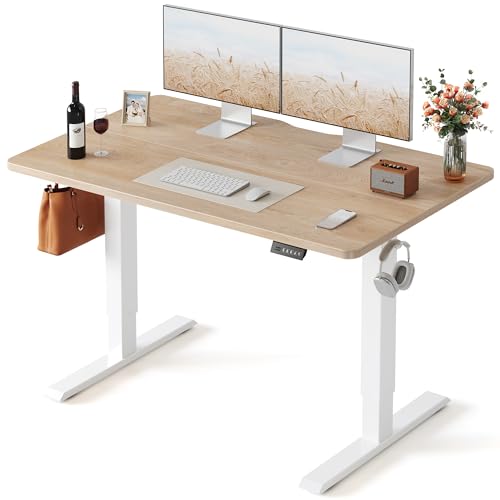
FEZIBO Standing Desk 48 × 24 Inch Electric Height Adjustable, Maple
$99.98 Check pricePrices change often - VIVO
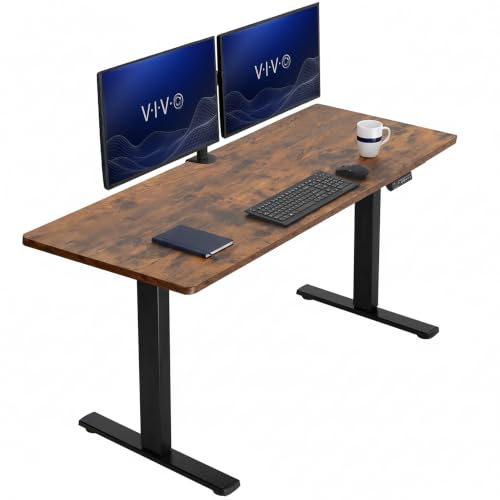
VIVO Rustic Vintage Brown 60 x 24 in Standing Desk, DESK-KIT-1B6N
$219.99 Check pricePrices change often



What does the lift capacity number actually include?
A published lift capacity is the load rating ABOVE the frame, and it normally EXCLUDES the tabletop itself. If a frame is rated for 220 pounds, that is 220 pounds of monitors, keyboard, decor and whatever else sits on top, not the top plus that load. The tabletop is a separate weight that the frame has to lift on top of its rated capacity.
This matters because tabletop weight varies enormously by material. A 48 by 24 inch laminate top runs around 33 pounds, while a 72 by 30 inch solid hardwood top can run around 95 pounds. Pairing a heavy solid-wood top with a lower-capacity frame eats into headroom you may have assumed was available for your monitors and gear.
| Top material and size | Approximate weight |
|---|---|
| Laminate, 48 x 24 in | about 33 lb |
| Engineered wood, 60 x 30 in | about 45 to 55 lb |
| Solid hardwood, 72 x 30 in | about 95 lb |
L-shaped and large-format frames
Shown across the range this category actually spans, from $189.98 to $719.99, rather than the cheapest few.
- Huuger
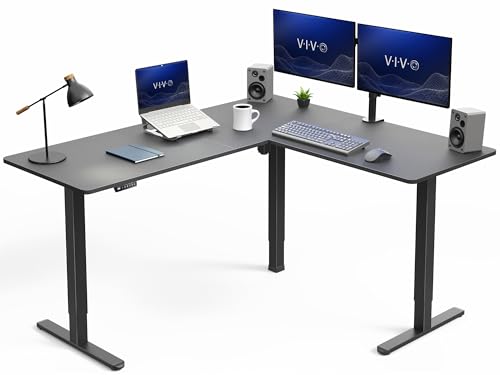
Huuger 63 x 55 Inch L Shaped Standing Desk with Power Outlets
$189.98 Check pricePrices change often - Curlaky
Curlaky Electric Standing Desk with Drawers - 70" Adjustable Computer Desk
$229.99 Check priceSeveral configurations share this listing name. The price shown is the one that differs. Prices change often - Curlaky
Curlaky Electric Standing Desk with Drawers - 70" Adjustable Computer Desk
$229.99 Check priceSeveral configurations share this listing name. The price shown is the one that differs. Prices change often




Why does minimum height matter more than maximum?
Almost every marketing page leads with the maximum standing height a desk can reach, but the spec that actually disqualifies a desk for a given buyer is usually the minimum. A frame that bottoms out at 28 inches will sit too high for a shorter seated user working from the reference ratios in the setup guide, no matter how impressive its maximum extension is.
Before buying, check the minimum height against your own seated desk height number, not just the maximum against your standing number. A desk that maxes out at 48 inches but only goes down to 30 inches is a poor fit for anyone whose seated number lands below that.
Converters if you are not replacing your desk
Shown across the range this category actually spans, from $99.99 to $179.99, rather than the cheapest few.


What is duty cycle and why does it limit how I use the desk?
Duty cycle describes how much of the time the motor can run continuously before it needs to cool down, and it is commonly rated at around 10 percent, meaning roughly 2 minutes of continuous movement followed by about 18 minutes of rest. This is rarely a problem for someone raising and lowering the desk a few times a day, but it matters for anyone planning to cycle the desk frequently in a short window.
A desk rated this way is built for a home office rhythm of a handful of height changes per day, not continuous motion, which is a reasonable match for how sit-stand desks actually get used in practice.
What frame types are available besides basic two-leg?
Beyond the standard two-leg frame, L-shaped standing desk frames add a return for a second monitor setup or storage, and typically need to handle the same weight class across a larger surface, which is worth checking against the same lift-capacity-excludes-the-top rule above. Large-format frames extend the same motor and load logic to bigger tops, generally in the higher end of the dual-motor range.
A standing desk converter sits on top of an existing fixed desk rather than replacing it, trading full desk depth for a lower cost and no frame installation. Converters do not carry the same motor-speed specs as full frames since most are manually adjusted or use smaller motors, and they are compared directly against full frames in the standing desk vs converter comparison.
How much load will my actual setup put on the frame?
A loaded desk with two monitors, a monitor arm, a laptop dock, a lamp and desk accessories rarely passes 600 watts of powered equipment and rarely approaches even the lower end of the single-motor load class in physical weight. Most home office setups stay well under 100 pounds of gear on the desktop, which means load class becomes the deciding spec mainly for buyers stacking heavy monitor arms, large secondary displays or added shelving.
Use the standing desk load calculator to add up your specific gear before assuming you need a dual-motor frame; many single-motor frames have more headroom than their price position suggests.
What should I check before checkout?
In order: confirm the minimum height clears your seated number, confirm the load class covers your gear weight plus your chosen tabletop weight, confirm the motor speed and duty cycle match how often you plan to change height, and confirm the frame width matches your tabletop rather than overhanging it unsupported.
Get the desk setup checklist
One page: the measurements to take, the order to set them in, and the numbers to check against. Free, no spam.
The mailing list opens shortly. Every measurement it covers is already on this site, in the calculators and the fit tables, at no cost and with no address required.
Questions people ask
Is dual motor worth the extra cost for a typical home office?
It depends on load and evenness of that load. If your setup is a single monitor and a laptop, a single-motor frame in the 150 to 220 pound class has plenty of headroom. If you run a heavy dual-monitor arm mounted off-center, or plan to add weight over time, dual motor is worth it for staying level under that uneven load, not just for the higher weight ceiling.
Does a higher weight rating mean the desk is sturdier at any height?
Not necessarily. The load rating describes capacity in normal operating range, not stability at full extension, which is a separate engineering question tied to frame geometry and leg spacing. A frame near its rated capacity while fully extended will generally wobble more than the same load at a lower height, regardless of the rating on the spec sheet.
Why does my new desk feel too high even though I set it to the "standing" ratio?
The standing height ratio of about 0.62 times body height is a convention starting point, not a guarantee. Recheck it the same way described in the setup guide: stand with relaxed shoulders and let your arms hang, then lower the desk until it meets your palms with elbows near 90 to 120 degrees, adjusting down from the calculated number if needed.
Can I put a solid wood top on any standing desk frame?
Only if the frame load class has room for it once you subtract the top weight from the rated capacity. Since lift capacity excludes the tabletop, a 95 pound solid hardwood top on a 150 pound-class single-motor frame leaves only about 55 pounds for everything else on the desk, which is tight for two monitors and a dock.
What does a 10 percent duty cycle mean for daily use?
In practice it means the motor is designed for short, occasional movements rather than sustained cycling, commonly described as about 2 minutes of continuous run time followed by about 18 minutes of rest. Raising or lowering the desk a handful of times through a workday stays well inside that limit for nearly every user.
Should I size the frame to my current desktop or buy top and frame together?
Either works as long as the widths match and you confirm the frame load class against the actual top weight once you know the material. Buying them separately gives more control over top material and finish; buying a bundled desk is simpler and guarantees the width and weight numbers are already compatible.