Standing Desk vs Converter
Quick answer
A standing desk converter is the right choice when you cannot or do not want to replace your existing desk, since it sits on top and lifts to standing height for about $140. A full electric standing desk is the right choice for a permanent setup, since it moves the entire work surface rather than adding a second platform on top of a fixed desk.
Researched from published product dimensions and specifications, plus verified owner reviews, rather than in-person testing.
The options
- Full standing desk
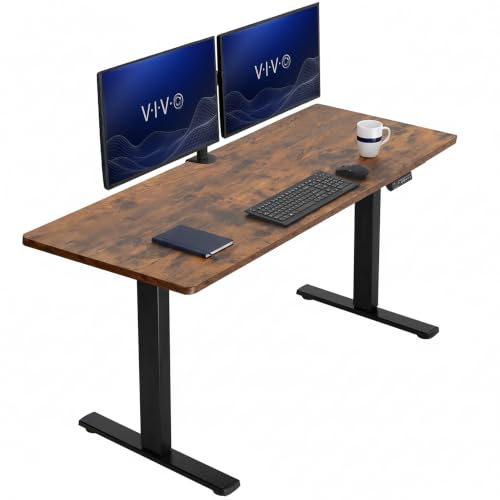
VIVO Black 60 x 24 in Standing Desk, DESK-KIT-1B6B
The VIVO Black 60 x 24 in Standing Desk, DESK-KIT-1B6B, an electric height-adjustable frame with a full-size top, at $199.99.
$199.99 Check pricePrices change often - Standing desk converter
VIVO Black 32 in Standing Desk Converter, DESK-V000K
The VIVO Black 32 in Standing Desk Converter, DESK-V000K, a desktop riser that sits on any existing desk, at $139.99.
$139.99 Check pricePrices change often


Best for: A permanent home office setup with one continuous surface across the full height range.
Avoid if: You rent, cannot install a new desk, or need to preserve your current desk.
Best for: Renters, shared desks, and anyone testing standing desk use before committing to a full frame.
Avoid if: Your existing desk is already too tall for you seated, since the converter only adds height, it never removes it.
| Specification | Full standing desk | Converter |
|---|---|---|
| Replaces existing desk | Yes | No, sits on top of it |
| Seated height calibration | Frame lowest setting sized for seated use | Existing desk height plus converter's own minimum |
| Portability | Fixed installation | Can move between desks or rooms |
| Renter-friendly | Requires a dedicated desk frame | Yes, no permanent installation |
| Surface continuity | One continuous surface at any height | Platform sits above the desk surface |
| Price at review | $199.99 (VIVO 60x24 frame) | $139.99 (VIVO 32 in converter) |
Why a converter can push your setup too high
A standing desk converter adds its own height, typically several inches at minimum, on top of whatever your existing desk already measures. If your current desk is a standard 29 to 30 in height, a converter's seated-mode height can land higher than an ergonomically ideal seated desk height for a shorter user, since the converter was not designed as a replacement desk surface calibrated to seated ergonomics from zero, but as an add-on platform that starts from your desk's existing height.
This matters most for anyone under about 5 ft 6 in, where a standard desk height plus a converter's minimum platform height can put the keyboard and mouse surface above a comfortable elbow angle even in the lowered, seated position. A full standing desk's frame is calibrated from the ground up, so its lowest setting is built specifically for seated ergonomics rather than being constrained by an existing desk's fixed height.
The renter and shared-desk case for a converter
A converter is the only realistic option if you rent and cannot install a permanent desk, share a desk with someone who does not want or need standing capability, or move between locations, such as a home office and a coworking desk, since it packs up and relocates far more easily than an electric frame. It also lets you trial standing desk use with a lower financial commitment before deciding whether a full frame is worth the larger investment and the disruption of replacing your existing desk entirely.
What you give up with a converter's smaller surface
Converters are sized smaller than most full standing desks by necessity, since the platform has to fit on top of an existing desk without overhanging dangerously. A 28 to 32 in wide converter accommodates one monitor and a keyboard comfortably, but adding a second monitor, a large monitor arm base, or a desk lamp starts to crowd the platform in a way a 55 to 60 in wide full standing desk simply does not.
The converter also creates two surface levels: the desk itself, still at its original fixed height, and the raised platform. Items on the desk surface around the converter, such as a phone, notebook, or coffee cup, stay at seated height even when the converter itself is raised to standing height, which some owners find awkward compared with a full standing desk where the entire surface moves together.
When the math favors buying the full frame outright
A full standing desk frame in the 199.99 range is not dramatically more expensive than a quality converter at 139.99, and it buys a permanent, single-surface solution without the seated-height compromise a converter introduces. If you know you want a standing desk long term, are not constrained by renting or a shared desk, and want a full-width surface for two monitors or additional gear, the price gap between a converter and an entry-level full frame is narrow enough that skipping the converter and buying the frame directly is often the more economical path once you account for not needing to replace the converter with a full desk later.
What both options share: the same duty cycle and load class rules
Once you look past the mounting difference, a converter and a full electric standing desk are governed by the same mechanical rules as any other lift mechanism: a rated load class that excludes whatever sits on the platform beyond the mechanism itself, and commonly a duty cycle limit around 10 percent, meaning roughly 2 minutes of continuous motion followed by an 18 minute rest before the next full cycle. A converter's platform weight, monitors, and keyboard all count against its rated capacity exactly the way a full desk's desktop and gear count against its own rating.
This means the desktop-weight math that applies to a full standing desk frame applies just as directly to a converter's platform. A converter loaded with a heavy monitor arm and two large monitors can approach its rated capacity the same way an undersized standing desk frame can, so check the converter's published weight rating against your actual gear before assuming a smaller platform automatically means a lighter overall load to manage.
Full electric standing desks
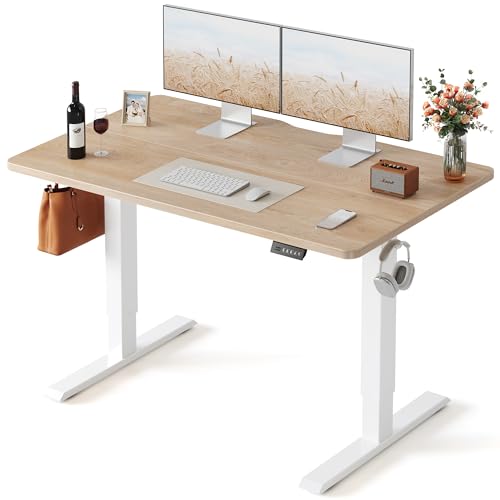
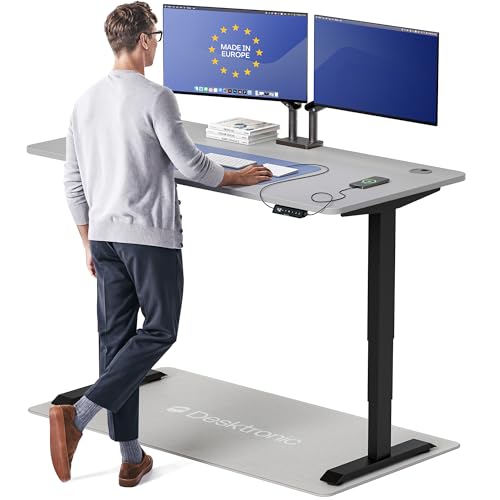
Shown across the range this category actually spans, from $99.98 to $679.99, rather than the cheapest few.
- FEZIBO
FEZIBO Standing Desk 48 × 24 Inch Electric Height Adjustable, Maple
$99.98 Check pricePrices change often - VIVO
VIVO Rustic Vintage Brown 60 x 24 in Standing Desk, DESK-KIT-1B6N
$219.99 Check pricePrices change often



Standing desk converters
Shown across the range this category actually spans, from $99.99 to $179.99, rather than the cheapest few.


Get the desk setup checklist
One page: the measurements to take, the order to set them in, and the numbers to check against. Free, no spam.
The mailing list opens shortly. Every measurement it covers is already on this site, in the calculators and the fit tables, at no cost and with no address required.
Questions people ask
Is a standing desk converter as good as a full standing desk?
It serves a different purpose rather than being a lesser version. A converter is the right tool when you cannot replace your existing desk, such as when renting or sharing a desk. A full standing desk gives a single continuous surface calibrated for seated ergonomics from its lowest setting and more usable width, which a converter, sitting on top of an existing desk, cannot fully replicate.
Will a standing desk converter be too tall for me?
Possibly, especially if you are shorter than about 5 ft 6 in and your existing desk is already a standard 29 to 30 in height. The converter adds its own minimum height on top of that, which can push the seated typing position higher than ergonomically ideal. Measure your existing desk height plus the converter's stated minimum height before buying.
Can I fit two monitors on a standing desk converter?
It depends on the platform width; a 28 to 32 in converter fits one monitor and a keyboard comfortably but gets crowded with two monitors plus accessories. Wider converters exist specifically for dual monitor setups, so check the platform width against your monitor count before assuming a standard single-monitor converter will work.
Do standing desk converters work on any desk?
Most freestanding converters work on any flat, stable desk surface deep enough to support the converter's footprint, typically at least 20 to 24 in of depth. They are not compatible with desks that are already unstable or too shallow to support the converter's base without overhanging the front or back edge.
Why is a full standing desk not much more expensive than a converter?
Entry-level standing desk frames have come down in price enough, often around $100 to $200, that the gap between a quality converter and a basic full frame is narrower than it once was. If you already know you want permanent standing desk capability, buying the frame directly can be more economical than buying a converter and later replacing it with a full desk.
Does a converter save desk depth the way a monitor arm does?
No, a converter adds a platform on top of the existing desk rather than recovering any depth; it typically needs as much or more depth than a monitor sitting directly on the desk with a factory stand. If desk depth is the concern, a monitor arm addresses that separately from the standing-versus-seated decision a converter or full desk addresses.