Every workstation dimension for someone 6 ft 5 in
Quick answer
A 6 ft 5 in body wants a seat at 19.3 in (49 cm), a seated desk at 31.6 in (80 cm), armrests 11.2 in above the pan, the top of the screen near 53.1 in (135 cm), and a standing desk height of 47.7 in (121 cm). Set them in that order: chair, then desk, then screen.
The stature multipliers behind this table are conventions, not published standards. Two people of the same height can differ by more than an inch in leg or torso length, which is exactly why ANSI/HFES 100 specifies adjustment ranges rather than single correct numbers.
| Order | Dimension | Target | The check |
|---|---|---|---|
| 1 | Chair seat height | 19.3 in (49 cm) | Feet flat, thighs level or sloping slightly down |
| 2 | Seat pan depth | 19.1 in (48 cm) | Two to three fingers behind the knee |
| 3 | Lumbar apex | 8.9 in (22 cm) above the pan | Fills the curve without pushing you forward |
| 4 | Armrest height | 11.2 in (28 cm) above the pan | Elbows rest, shoulders stay down |
| 5 | Seated desk height | 31.6 in (80 cm) | Forearms parallel to the floor, wrists straight |
| 6 | Screen top edge | 53.1 in (135 cm) | At or just below eye height |
| 7 | Screen distance | 25 to 32 in for a 27 in panel | Whole screen readable without leaning in |
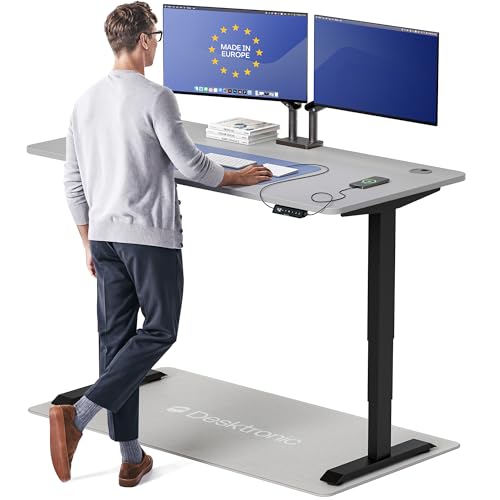
| 8 | Standing desk height | 47.7 in (121 cm) | Same elbow rule, standing |
| Clearance | Minimum | Why |
|---|---|---|
| Knee height under the surface | 25.8 in (65 cm) | Thigh depth above the seat pan |
| Knee depth, front edge inward | 15 in | Room for the knees without meeting a drawer or a frame |
| Toe depth at floor level | 23 in | Room to push the chair back and sit close |
| Width of clear leg space | 20 in | Keeps the legs out of the frame and cable tray |
Everything this workstation needs
Shown across the range this category actually spans, from $19.99 to $679.99, rather than the cheapest few.
- CasaZenith
CasaZenith Foot Rest, Six Heights Adjustable Foot Rest Under Desk at Work
$19.99 Check pricePrices change often - ErgoSift
ErgoSift Ergonomic Office Chair with Adjustable Seat Depth, 4D Armrests
$99.99 Check pricePrices change often - SIHOO
SIHOO M57 Ergonomic Office Chair, Mesh Back Desk Chair with 3D Armrests
$199.99 Check pricePrices change often - VIVO
VIVO Reclaimed Wood 60 x 24 in Standing Desk, DESK-KIT-1B6P
$219.99 Check pricePrices change often


The order is the whole trick
Adjust the chair first, the desk second, the screen third. Almost everyone does it backwards, because the desk is already at whatever height it came at, so the chair gets set to suit the desk and the body absorbs the difference. Starting from the chair means the body is supported correctly before anything else is allowed to have an opinion.
For a 6 ft 5 in body that means the pan goes to about 19.3 in first, with the feet flat. Then the desk comes to 31.6 in, or if it will not move, the chair goes up to meet it and a footrest goes under the feet. Only then does the screen get set, because screen height depends on seated eye height, and seated eye height is not known until the chair is right.
What to change if the numbers cannot be met
A fixed 29 in desk is the usual obstacle, and for this body the seated target is 31.6 in, a gap of 2.6 in. The cheap fixes in order of effectiveness are a keyboard tray, which lowers the working surface by 2 to 3 in, a taller chair plus a footrest, and desk risers, which go the other way for a desk that is too low.
Screen height is almost always fixable for very little. The top edge wants to be near 53.1 in from the floor, and if the factory stand will not reach, an arm or a riser will. Of the two, an arm is the one that keeps working when you change posture or switch the desk to standing, because it can move independently of the surface it clamps to.
Questions people ask
What are the correct desk and chair heights for someone 6 ft 5 in?
Seat at 19.3 in (49 cm), seated desk at 31.6 in (80 cm), standing desk at 47.7 in (121 cm), and the top of the screen near 53.1 in (135 cm). Set the chair first, then bring the desk to your elbows, then set the screen. These are planning conventions, so confirm each one by the joint angle rather than the tape measure.
What order should I adjust everything in?
Chair, then desk, then screen. The chair decides where your body sits, the desk has to meet your elbows from there, and screen height depends on your seated eye height, which is not fixed until the chair is. Adjusting in any other order means each step invalidates the one before it.
How much knee clearance does a desk need?
For this body the underside of the desk has to clear about 25.8 in so the thighs fit above the seat pan, with roughly 15 in of clear depth for the knees and 23 in at floor level for the toes. Cable trays and drawers are the usual offenders, and they are easy to overlook until the desk is built.
Do these numbers work for everyone of this height?
They are a starting point, not a measurement of you. People of the same height differ in torso and leg proportion by more than an inch, which is precisely why published standards specify adjustment ranges instead of single figures. Use these to narrow the search, then adjust by feel using the checks in the table.